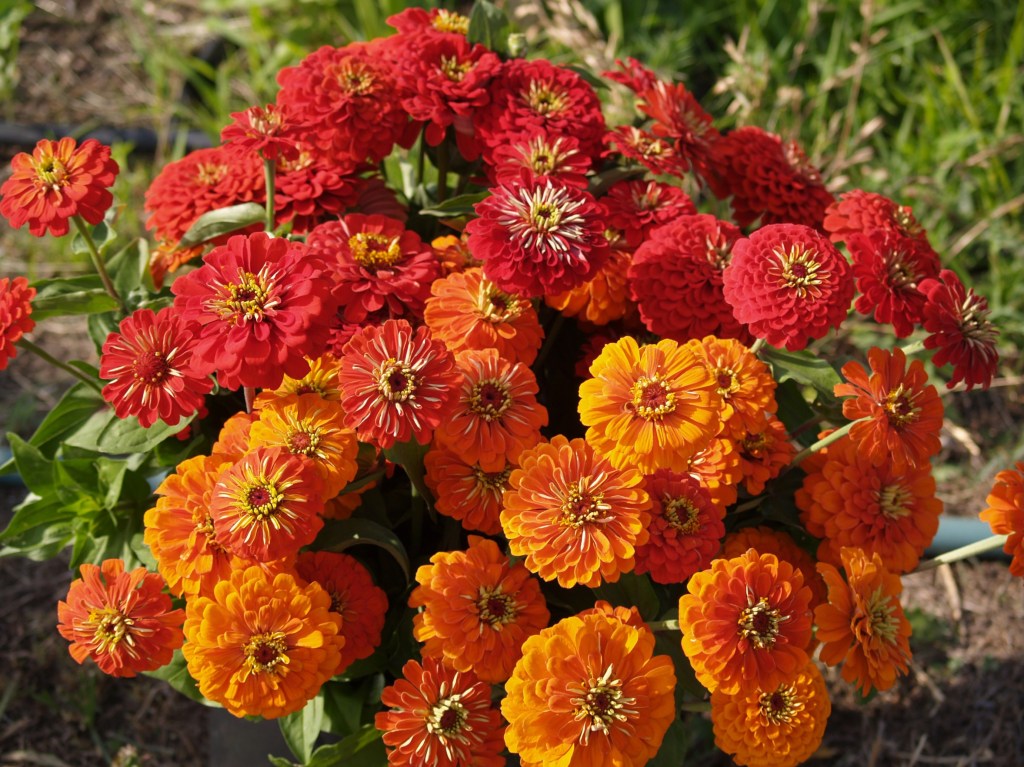
Zinnias are one of the easiest and most carefree flowers you can grow, if you provide the right conditions. They need full sun to perform well. They can be grown with as little as six hours of sun per day, but they will bloom later and less profusely, and the plants will not be as strong and may need to be staked.
People differ on whether zinnias should be started indoors or direct seeded outdoors. By starting indoors, you get a month head start and earlier blooms; however, if you disturb the roots when transplanting, double varieties may bloom as singles or semi doubles until they have recovered from the stress. Direct seeding outdoors avoids transplant shock, but you must wait until the soil is thoroughly warm for best seed germination.
Indoors
Start zinnia seeds four weeks before your frost-free date. Cover the seeds with 1/4” of soil in a flat on a heat mat set to 80F. With bottom heat, they will come up in two or three days. At cooler temperatures, it may take five to seven days. As soon as the seedlings have one set of true leaves, transplant them into a 72-cell or 50-cell flat. Place a grow light 2 inches above the top of the seedlings, and raise it as they grow. Harden off the tender plants by placing them outside for a while each day, starting with just one hour and increasing the amount of time they are exposed to outdoor conditions until they can be transplanted.
After all danger of frost is past and the plants are hardened off, plant them in the garden. Space them 9-12” apart for cut flowers, up to 18” apart for landscaping.
Outdoors
After the weather is settled, plant zinnia seeds 1/4“ deep in the garden. Space the seeds 6-9” apart and thin to 9-12 inches after you see (and like) the first bloom.
Protect plants from rabbits, which find zinnias especially tasty.
Pinching
You can pinch out the first bud on a zinnia plant to encourage branching, and this is the recommended practice for landscape displays. For cut flowers, though, you can wait until the first bud opens, then cut it with a sufficiently long stem for your use. That first cut may sacrifice several short stems. However, zinnias will continue to produce below the cut, which leads to long stems on later flowers. For breeding, don’t pinch because you want to see the flowers as soon as possible.
Support
Grown in full sun, zinnias usually don’t need any kind of support. However, if you do see them tilting in one direction, you can usually “corral” them by putting stakes and twine around the planting. If you don’t have a spot that is sunny all day, you should expect that support will be needed. Professional growers use a product called trellis netting — it’s plastic so not ideal, but it will last several years if you handle it carefully. A quick search online will lead you to suppliers and information about how to erect the net horizontally so your plants grow through the net.
Harvest
Pick zinnias after the stem below the flower has grown stiff. To be sure you are harvesting at the right time, hold the stem just above where you want to cut it, and move the flower side to side, If it wiggles, it’s too soon. (That’s widely known as the wiggle test!) Zinnias are cold sensitive so should not be stored in a refrigerator. Vase life is 7-10 days.

 Flower Territory
Leave a comment